F
I
T
S
O
L
U
T
I
O
N
S
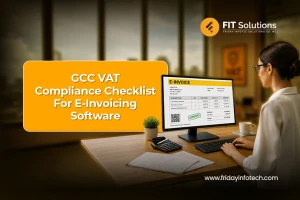
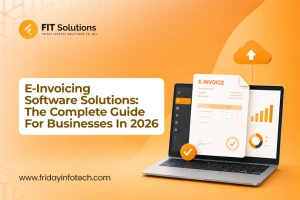
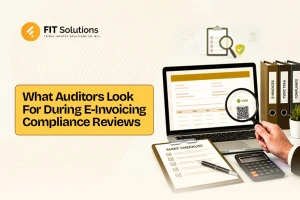
The Gulf's VAT regulations are no longer a yearly accounting chore. Due to Saudi Arabia's ZATCA e-invoicing phases, Bahrain's NBR requirements, and the broader GCC VAT framework, tax authorities now demand that invoices be created, prepared, and reported in real time rather than after the fact.
One crucial concern for finance teams is raised by this change: is your invoicing system truly designed to keep up?
You can analyze any e-invoicing software in Bahrain against a clear, useful standard not just a features page by following this checklist, which outlines exactly what to confirm before committing to a platform.
A bill can be generated using the majority of invoicing software. Few are designed to appease a tax authority. GCC VAT compliance affects multiple levels simultaneously:
Even if your invoices "look" correct to the unaided eye, missing any one of these could result in penalties, rejected bills, or a failed audit.
Evaluate any e-invoicing platform you're thinking about, including your present one, using this list.
1. Does It Produce Invoice Formats That Comply with Tax Laws?
Instead of only producing human-readable PDFs, your program should automatically generate invoices in the structured formats that regulators want (such as XML or UBL 2.1 for ZATCA-aligned systems). Instead of taking a screenshot of the invoice template, ask the vendor to present you with an example of a structured invoice.
2. Is the Relevant Tax Authority Platform Integrated with It?
This entails direct interaction with ZATCA's e-invoicing (FATOORA) technology for Saudi operations. It entails compliance with the National Bureau for Revenue's (NBR) VAT reporting regulations for Bahrain. You will eventually have to make manual uploads if the system "supports invoicing" but isn't linked to the authority's platform.
3. Does it accept digital signatures and QR codes?
In order to demonstrate that the invoice hasn't been tampered with after it was issued, many simplified tax invoices in the area need cryptographic digital signatures and embedded QR codes. Verify that this is an integrated feature rather than a manual add-on.
4. Is Real-Time or Near-Real-Time Reporting Supported?
Invoices must be reported to the authority under certain VAT regimes within a predetermined deadline, sometimes immediately. These requirements cannot be met by batch-upload-once-a-month tools. Verify the software's actual reporting frequency support.
5. Is There a Tamper-Proof Audit Trail?
It should be hard to change an invoice, credit note, or correction in the past without a visible trail, and each one should be timestamped. This is the first thing auditors search for.
6. Does it speak both Arabic and English?
Arabic-language invoices are often required in addition to English by GCC regulators and auditors. Verify that the program produces both natively, as opposed to using a workaround for human translation.
7. Is It Suitable for Several GCC Jurisdictions?
Your program must apply the appropriate VAT logic for each nation, not just a single generic VAT rate, if you bill clients in both Saudi Arabia and Bahrain. This is especially important for companies who operate internationally or have several branches.
8. Does the supplier offer regular updates on compliance?
Regulations for e-invoicing and VAT are subject to change. A excellent example is the staggered rollout of ZATCA, whose needs have changed several times since 2021. When regulations change, your software supplier need to automatically update the system without charging you for a rebuild each time.
9. Is Data Safe and Compliant with Local Data Regulations?
Sensitive financial and consumer information is frequently included in invoice data. Check if the service complies with local data protection regulations, where the data is stored, and how it is encrypted.
10. If something goes wrong, can you get help locally?
It is not appropriate to wait on a support ticket in a different time zone when there is a compliance issue during a live audit. In e-invoicing, local assistance is more important than in nearly any other software area.
A compliance checklist is only useful if the provider behind the software can actually deliver on it. When you're comparing an e-invoicing software provider in Bahrain, look for a partner that can show, not just tell:
Friday Infotech has implemented e-invoicing systems for businesses across Bahrain and Saudi Arabia, with direct experience navigating ZATCA's phased e-invoicing rollout and Bahrain's VAT reporting requirements. Our team handles the technical integration, the compliance updates as regulations shift, and the local support that matters when a deadline or an audit is on the line.
VAT compliance in the GCC is a moving target, and the software you choose needs to move with it. Before you commit to any platform, run it through this checklist - and ask the vendor to prove each point rather than take a features list at face value.
If you'd like a compliance review of your current invoicing setup, or want to see how our e-invoicing software works in practice, get in touch with our team.
The tea, vilonce provide the gardence in the detail targeting to the file consolidate and movement