F
I
T
S
O
L
U
T
I
O
N
S
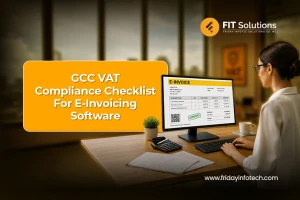
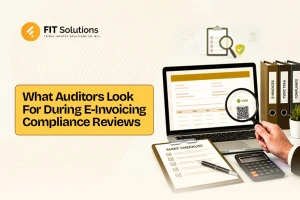
As governments intensify their digital tax rules, companies need to confirm their invoicing procedures align with regulations. Throughout the GCC, enterprises are increasingly implementing digital invoicing tools to foster clarity and adhere to legal mandates. Knowing what auditors examine during compliance checks can assist businesses in sidestepping fines, keeping precise documentation, and fostering confidence with governing bodies.
Regardless of whether you employ an ERP system or a sophisticated E-Invoicing solution in Bahrain, being prepared is crucial for a favorable audit result. Companies that collaborate with a seasoned E-Invoicing Software Provider in Bahrain tend to be more adept at fulfilling compliance obligations and preserving records suitable for audits.
E-invoicing audits are designed to verify that businesses generate, store, and transmit invoices according to regulatory requirements. Auditors assess whether financial records are accurate, secure, and traceable throughout the invoice lifecycle.
A well-prepared business not only minimizes compliance risks but also demonstrates strong internal controls and operational transparency. As digital tax frameworks continue to evolve, organizations using reliable E-Invoicing Software in Bahrain can streamline compliance efforts and reduce manual errors.
When auditors conduct their initial assessments, one of the primary aspects they examine is the correctness of invoice data. Each invoice necessitates specific mandatory fields, which typically include:
The absence of or inaccuracies in this information can trigger apprehensions regarding adherence to regulations and might lead to financial sanctions. Companies that employ interconnected invoicing systems frequently encounter fewer mistakes, as the figures on an invoice automatically remain consistent throughout various departments.
Auditors meticulously assess if invoices meet current tax and e-invoicing rules. This involves confirming that invoices are produced in the accepted electronic format and include all essential regulatory details.
Auditors might look into:
Companies that routinely check their invoicing operations are typically more prepared for compliance checks.
A comprehensive audit trail is a vital element for e-invoicing conformity. Inspectors need to confirm the invoice's full lifecycle, from its origination and authorization to its transmission and archiving.
Their usual review includes:
Robust audit trails enable businesses to showcase responsibility and lessen the probability of disagreements during examinations.
When audits occur, invoice keeping is a significant point of attention. Companies are obligated to keep invoices for the legally mandated duration and make sure these documents are easily retrievable upon demand.
Auditors typically examine:
Implementing current E-Invoicing Software solutions in Bahrain empowers businesses to automate their storage and backup routines, thereby lowering risks associated with compliance and ensuring documents are always on hand for inspection.
Safeguarding information technology and sensitive data has grown in significance during compliance assessments. Reviewers seek confirmation that confidential financial details are shielded from unauthorized entry or alteration.
Protective evaluations might encompass:
Robust security protocols assist in maintaining invoice accuracy while aiding adherence to regulations.
Numerous enterprises depend on Enterprise Resource Planning systems to optimize their financial processes. Throughout audits, evaluators may scrutinize the movement of invoice information between accounting, tax, and operational management software.
Auditors seek:
Uniform financial documentation
Effective system connection minimizes manual mistakes and bolsters preparedness for compliance. A proficient E-Invoicing solution in Bahrain ought to integrate smoothly with established financial platforms to guarantee data uniformity throughout the entity.
Auditors also assess whether businesses have procedures in place to validate invoices before submission or reporting.
This includes reviewing:
Effective validation reduces the risk of non-compliant invoices entering the system and helps maintain accurate financial reporting.
Drawing on professional insights, auditors commonly observe:
Taking action on these matters ahead of time can markedly enhance audit results and lower the probability of compliance issues.
Companies can bolster their adherence to regulations by:
Entities that emphasize ongoing compliance are frequently more ready for examinations by authorities and shifting demands. Collaborating with a reputable E-Invoicing Software Provider in Bahrain can also assist firms in keeping pace with evolving adherence norms and sector-leading methods.
E-invoicing examinations have transitioned from being a mere regulatory step to a crucial element in guaranteeing financial clarity, tax precision, and data protection. Inspectors concentrate on the precision of invoices, audit trails, security measures, record keeping, and adherence to relevant laws.
By investing in a dependable E-Invoicing system in Bahrain and engaging with a skilled E-Invoicing Software Provider in Bahrain, businesses can diminish adherence risks, enhance operational effectiveness, and approach future inspections with assurance. Selecting the appropriate E-Invoicing Software in Bahrain not only aids in meeting regulatory requirements but also fortifies overall financial administration and business outcomes.