F
I
T
S
O
L
U
T
I
O
N
S
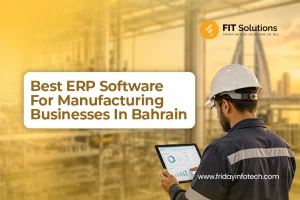
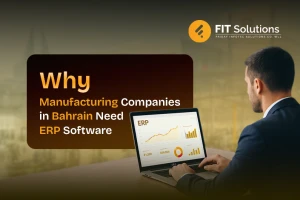
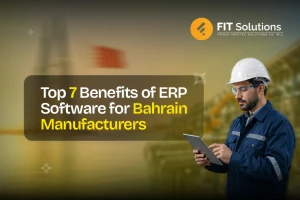
Manufacturing industry in Bahrain, which includes aluminium, metal manufacturing, food processing, packaging, and light industrial products, faces difficulties to modernize. The rise in raw material prices, VAT regulations and competitiveness of manufacturers across GCC imply that relying on spreadsheets and unsynchronized systems will not work for manufacturers anymore. In this regard, a suitable ERP software solution plays a crucial role.
Regardless of whether you run a medium-sized factory in Sitra or a growing manufacturing unit in Hidd, having the right ERP software for manufacturing industry in Bahrain can change your business operations. In this guide we will explain what features to pay attention to in ERP software and how to find a viable solution that corresponds your budget and requirements, including software designed specifically as ERP Software for Small Business in Bahrain.
Manufacturing businesses juggle far more moving parts than typical trading or service companies. A single production run touches procurement, raw material inventory, shop-floor scheduling, quality control, finance, and finally sales and delivery. Without a unified system, these functions operate in silos — leading to stock shortages, production delays, and inaccurate costing.
An ERP system solves this by binding every business function into a single platform, giving manufacturers:
Local manufacturers have already seen the impact of ERP adoption. Awal Gulf, a Bahrain-based manufacturer producing hundreds of thousands of cooling units annually, implemented an ERP platform across its Sitra and Hidd facilities specifically to gain supply chain visibility, manage warehousing and production costs, and support its multi-plant operations — a clear example of how ERP scales with manufacturing complexity.
Not a single ERP system is designed for manufacturing purposes. When considering other options, make sure to select the platforms that include:
1. Production Management and Manufacturing Management
The ERP solution should help manufacturers plan and manage production capabilities, BOM (bill of materials) planning, and resource distribution based on the company's previous operations and the market demand.
2. Management of Inventory and Warehouses
Manufacturers need to have an accurate control of their raw materials, semi-manufactured and manufactured products in order to avoid cases of overstocking or halting the production process.
3. Management of Purchases and Supply
The integrated purchase management module can facilitate the process of supplier management, processing purchase orders and payment to suppliers.
4. Financial and VAT Compliance
It is important that the ERP system automatically calculates and reports on VAT in Bahrain since the VAT rate is 10%.
5. Quality Control and Traceability
Batch tracking and quality monitoring contained in the system will help manufacturing companies in minimizing the number of defects and making recalls in cases that might require it.
6. Supporting Multiple Currencies and Branches
It is required that the system support different currencies since a huge number of Bahraini companies export across the GCC.
7. Cloud Accessibility and Mobile Access
Cloud-based ERP is increasingly the norm in Bahrain, offering lower upfront costs, easier scalability, and the ability for managers to access real-time data remotely — a major advantage for owners overseeing multiple production sites.
Bahrain's market is steadily shifting toward cloud ERP adoption, driven by lower infrastructure costs and government initiatives supporting digital transformation across local industries. Cloud ERP eliminates the need for in-house servers and IT maintenance teams, which is particularly attractive for growing manufacturers that want to avoid heavy upfront capital expenditure.
That said, some larger manufacturers with strict data residency requirements or highly customized production workflows still prefer on-premise or hybrid deployments. The right choice depends on your company's size, IT capacity, and long-term growth plans.
A common misconception is that ERP systems are only for large factories. In reality, ERP for small business in Bahrain has become far more accessible in recent years, with vendors offering modular, subscription-based pricing that scales as your operations grow.
Small and mid-sized manufacturers benefit just as much if not more from ERP adoption because:
If you're a small manufacturer just starting your digital transformation journey, look for ERP vendors in Bahrain that explicitly offer packages designed for smaller operations rather than enterprise-only pricing tiers.
Before committing to any ERP software, manufacturers in Bahrain should evaluate:
Choosing the best ERP software for manufacturing businesses in Bahrain isn't just about picking a well-known brand it's about matching the system's capabilities to your production complexity, compliance needs, and growth stage. Larger manufacturers may need robust, multi-plant systems with deep supply chain visibility, while smaller operations are often better served by affordable, modular ERP for Small Business in Bahrain solutions that can scale over time.
Whichever path you choose, the goal remains the same: replacing manual processes and disconnected spreadsheets with a single, real-time system that gives you full control over production, inventory, finance, and compliance — helping your manufacturing business stay competitive across Bahrain and the broader GCC market.